Roadmap
Where things stand
xatc flies a full IFR flight gate to gate: from the ATIS and the clearance at a gate, through pushback, taxi, takeoff, departure, Center, the arrival, the approach and the landing, to taxi-in and parking. It all runs by voice, at any airport X-Plane's scenery covers, with a deterministic engine deciding every word ATC says.
| Milestone | Status | What it covers |
|---|---|---|
| M0: spikes | ✅ done | X-Plane Web API, apt.dat and atc.dat parsing, sim weather, the voice round trip |
| M1: ground ops | ✅ done | ATIS, IFR clearance, taxi with hold-shorts, the radio panel, wrong-frequency silence |
| M2: voice | ✅ done | Transcribe + Polly, push-to-talk, the VHF radio effect |
| M3: departure | ✅ done | Tower takeoff clearance; Tower → Departure → Center; a CIFP-assigned SID; readback checking; the conformance monitor |
| M4: arrival | ✅ done | Descent via a STAR, approach clearance, landing clearance, taxi-in, go-around and parking |
| M5: realism | ✅ done | ATIS-letter checks, en-route pilot requests, emergencies and special squawks, pushback (details below) |
| M6: VFR | ✅ done | Pattern work (M6-1), flight following (M6-2), and Class B/C/D airspace entry (M6-3), details below |
| M7: traffic awareness | 🔶 in progress | Advisory, sequencing (M7-3) and wake turbulence (F11, F12) logic, now fed by a live X-Plane traffic feed -- not yet confirmed against real AI traffic on a running 12.4.3 |
M5: the most common "real ATC" interactions
- ATIS-letter check. Report an old letter on first contact with Clearance, Ground or Approach and ATC answers "information Bravo is current, altimeter …". Report none and it asks you to "advise you have information Alpha" (7110.65 2-9-3).
- Pilot requests en route.
- "request direct <fix>" gets "cleared direct …", or "unable" if the fix isn't on your route.
- "request higher / lower / flight level <n>" gets a new altitude.
- Weather deviations are approved with "advise when able to proceed direct …".
- "unable" takes back the last instruction and restates the one before it.
- Emergencies. "Mayday" or "pan-pan" (or squawking 7700, transponder on or in ALT) gets "say souls on board and fuel remaining". 7600 (lost comms) gets "if you hear this transmission, ident". 7500 gets one discreet verification. "Cancel mayday" ends it and restores conformance callouts, which otherwise go quiet during an emergency -- still logged for the debrief's own Radio events section.
- Pushback. "request pushback" gets "push back approved, tail <direction>". The direction comes from the taxilane behind your stand and which way it leads to the departure runway. An IFR flight needs its clearance first -- ask before you have it and Ground answers "clearance on <frequency>" instead.
M6-1: VFR pattern work at a towered airport
- Set VFR on the Settings Flight tab with the destination the same as departure (ADR 0008), and Ground taxis you out with no IFR clearance at all.
- Closed traffic. "cleared for takeoff, make right closed traffic" -- the side comes
from the airport's own
1101pattern data, left by default. - The circuit. Climb through 40% of the way to pattern altitude (400 ft for a piston, 600 for a turbine or jet) and Tower says "report midfield downwind"; call it and get "cleared for the option" (touch-and-go/stop-and-go/option) or "cleared to land" (full stop, the default) -- "number one" either way, since it's always just you.
- Pattern altitude is by aircraft category (F8): 1,000 ft AGL for a piston, 1,500 for a turbine or jet, by ICAO type designator.
- Pattern-altitude and leaving-the-pattern conformance, plus landing-without- clearance reused for every circuit -- see VFR pattern work.
M6-2: VFR flight following
- Leaving Tower's airspace. Climbing through 1,000 ft AGL after a VFR takeoff to another airport, Tower says "frequency change approved" -- no handoff, it's yours from there.
- Requesting it. "request flight following to <airport>" (or "VFR advisories") to Departure, Approach or Center gets a squawk, then "radar contact …" once your transponder actually shows it, on or in ALT.
- Handoffs, Departure/Approach → Center → destination Approach, use the same machinery (and the same "are you with me?" reminders) as an IFR flight's.
- Conformance only while following. With no IFR clearance, nothing is checked at all until radar contact -- then altitude, heading, speed and squawk are watched exactly like an IFR flight's.
- Termination, within 10 nm of the destination: "radar service terminated, squawk VFR, frequency change approved." See VFR flight following.
M6-3: VFR Class B/C/D airspace entry
- Class B needs a request. "request Bravo clearance" gets "cleared into the Class Bravo airspace, maintain VFR at or below <altitude>"; entering uncleared gets an escalating callout.
- Class C and D just need contact. Ordinary two-way radio contact (the controller using your callsign) satisfies it -- no request needed; entering before that gets an escalating callout naming the airspace.
- Class B altitude limit (F10): climbing above your cleared "at or below" altitude gets its own escalating callout. See VFR Class B/C/D airspace entry.
M7: traffic awareness
- M7-1 (ADR 0010) laid the groundwork: a
TrafficTargetsnapshot type and the geometryatc/traffic.pyneeds. - M7-2 wired a full advisory pipeline into the engine and phraseology: "traffic, twelve o'clock, five miles, opposite direction, Boeing seven thirty seven, altitude indicates same altitude," from whoever has you airborne, with backoff and "traffic in sight" handling. See Traffic advisories.
- M7-3 sequences behind traffic: "number two, follow the Boeing seven thirty seven on a five mile final, report it in sight" on approach, "continue" while the runway's occupied in the VFR pattern, with a wake-turbulence caution folded in behind a Heavy or Super.
- F11, F12: wake turbulence cautions. A takeoff or landing clearance on a runway a Heavy or Super used recently (2 minutes behind a Heavy, 3 behind a Super) ends with "caution wake turbulence" -- close parallel runways under 2,500 ft apart count as one for this, crossing runways don't. See Traffic advisories.
- The live X-Plane traffic feed reads the shared TCAS target arrays that AI traffic, multiplayer plugins and X-Plane's own TCAS all write to, about once a second, and is what actually turns on all three of the above in a real flight. Parked aircraft on the ground are ignored throughout. Not yet confirmed against real AI traffic on a running X-Plane 12.4.3 -- see Traffic advisories.
- F10 also gave KBFI's Class D real Laminar Research atc.dat data in its test coverage, replacing a synthetic placeholder.
- A real bug, fixed: an
apt.datfile that spells a runway inconsistently between its own row and its hold-short rows (e.g. KLAX's "6R" vs. "06R") could falsely flag a clean, correctly-flown runway crossing as an incursion, or name the wrong runway end in a taxi instruction or an incursion event -- confirmed at real airports (KLAX, KJFK) and fixed everywhere runway ids get looked up. See Conformance monitor and Taxi routing & hold-shorts.
Also built along the way
- F13: live-sim robustness. A live X-Plane session pausing, replaying, being repositioned or slewed, or starting a new flight altogether no longer trips a bogus conformance callout, a stuck timer, or a flight that thinks it's still where it used to be. See Live-sim robustness.
- F15: en-route "next fix" tracking. ATC keeps track of where you are on your filed route -- the next fix, direct-tos, cross-track for lateral conformance, and the descent's own timing all measure against it, and the panel's Route map draws it. See Route tracking.
- F16: approach vectoring. With no STAR (or after a missed approach), Approach builds and flies an actual pattern -- straight-in, base entry or downwind -- instead of pointing you at one spot on the final. See Arrival.
- F17: conversational ATC. A call the rules parser can't place goes to an LLM that can only pick one of a small, closed set of actions (a heading, an altitude, a direct-to, "unable", or a short factual answer) -- never free-form ATC. See Intent parsing & LLM modes.
- Voice is always on (ADR 0012): no more
voice.enabledsetting or--no-voiceflag -- push-to-talk voice is what xatc is for, not a toggle. See Voice for the details. - Versioned docs and GitHub Releases (ADR 0009). This site is versioned to match xatc's own releases, published alongside a tagged GitHub Release each time. See Versions.
- Any airport. Airport, procedure and airspace data comes straight from your X-Plane install, including Custom Scenery priority, X-Plane's own CIFP files and fix coordinates. It was checked against 15 real airports, which found and fixed three real bugs.
- Center sector and ARTCC handoffs, and "are you with me?" reminders after any handoff you don't check in from.
- Settings page (ADR 0007). Run
xatcwith no arguments and configure everything from the panel: the flight plan (manual or SimBrief), the connection, voice, ATC options and advanced settings. Command-line flags remain as per-run overrides. - Push-to-talk from hardware -- straight from X-Plane's own joystick datarefs by default (Windows and macOS), or a joystick/yoke library directly (Windows only) -- the post-flight debrief, and distance-based signal strength.
- An FAA JO 7110.65 phraseology audit. A golden test suite cites the paragraph each transmission follows, with pronunciation overrides for local fix names ("Iceberg", "King Dome").
- Windows setup:
xatc doctor,xatc smoke --live,setup-windows.ps1and a double-clickxatc-run.cmd. See Getting Started.
See Features for the per-feature "available now" breakdown.
What's next
- Confirming the live traffic feed against real AI traffic on a running X-Plane
12.4.3 --
xatc smoke --live --tcas-seconds 5is how; see Traffic advisories. - F18: AWS sign-in and status. A guided AWS CLI sign-in walkthrough and a clearer picture of what's actually connected, from the panel.
- Minimum vectoring altitudes. A follow-up to approach vectoring: real MVA data instead of just stepping the altitude down toward the approach altitude.
- F19: a Windows installer (proposed ADR 0013 in the repository) -- a setup wizard (Inno Setup, a bundled Python runtime, no uv or git clone needed) producing one installer per release, attached to its GitHub Release.
Where it's heading
The target architecture. Green is built today, amber is next, and dashed is later work. Everything runs on the Windows PC next to X-Plane, reading the sim's own data files. AWS only listens (Transcribe), speaks (Polly) and optionally helps classify what the pilot said (Nova Lite). The deterministic engine decides every word ATC says.
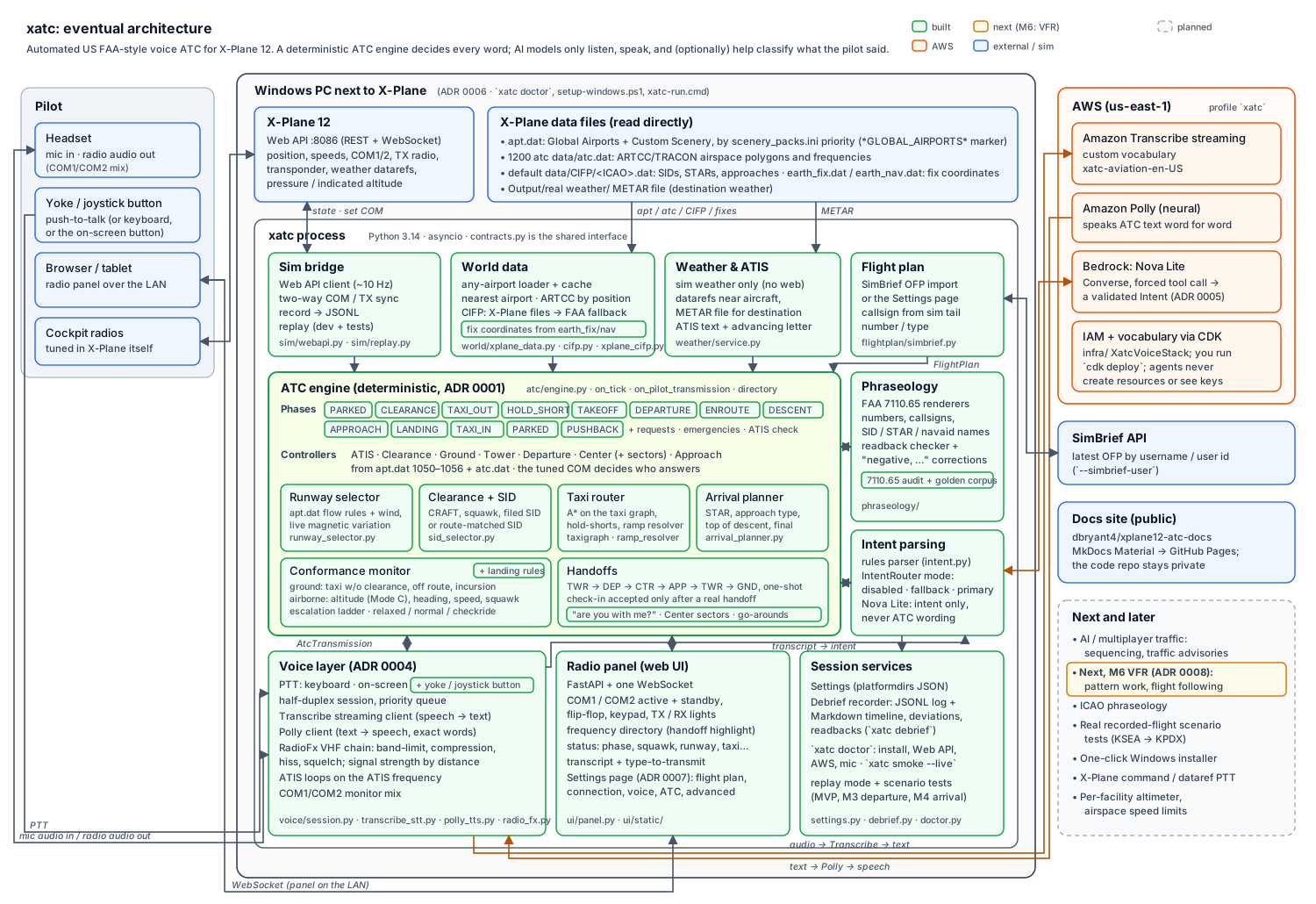
Click the diagram to open it full size.
Longer term
- ICAO (non-US) phraseology.
- A one-click Windows installer.
- Per-facility altimeter settings and airspace speed limits (91.117(b) and (c)).